

THINGS CHANGE ACCORDING ON HOW THEY ARE ILLUMINATED

Excerpt from the “Showlight” Conference. Dijon, France. 2025

Reading Time: 7 min.
On the occasion of the “Showlight 2025” conference, we illustrated, through a series of concrete examples of completed projects, the relationship between the lighting of a theatrical work and that of an architectural work or a work of art.
We began with an analysis of churches, within which these different forms of lighting alternate.
Places of Worship and the Changing Light
Churches have always been a theatre, the place where liturgy and community life take place. Over time, their lighting has evolved, shaped by the technologies available and by the spirit of different eras. In Byzantine churches, for example, light reflected by golden mosaics represented the divine grace that embraces everything. In Romanesque churches, small windows allowed only a faint light to filter through, reflecting a world marked by guilt and penance. Gothic cathedrals, by contrast, open themselves to light: immense stained-glass windows flood the interiors with natural light, lifting the gaze towards a luminous sky.
In Byzantine churches, for example, light reflected by golden mosaics represented the divine grace that embraces everything. In Romanesque churches, small windows allowed only a faint light to filter through, reflecting a world marked by guilt and penance. Gothic cathedrals, by contrast, open themselves to light: immense stained-glass windows flood the interiors with natural light, lifting the gaze towards a luminous sky. Speaking of Gothic architecture, we discussed the lighting project for Milan Cathedral, on whose implementation we collaborated some years ago.

Maestà di Cristo in trono tra i Santi Pietro e Paolo. gold-ground mosaic. Palazzo dei Normanni, Palermo. © Jacques Savoye
Cathedrals, in addition to being places of worship and celebration, are also historical monuments rich in details, decorative friezes and sculptures. Places that oscillate between museum spaces, places of rites and celebrations, and pilgrimage destinations. The lighting of a place of worship, and even more so of a cathedral, must be capable of combining all these aspects, which together contribute to defining its identity.
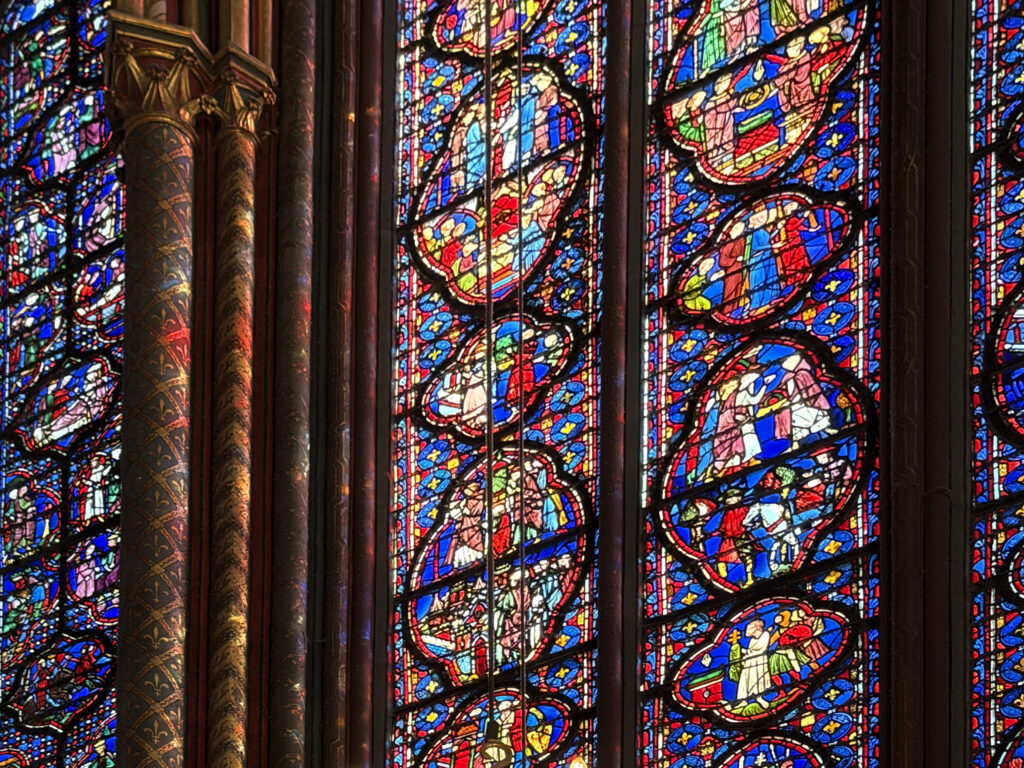
Saint-Chapelle. Details of the stained-glass windows. © Marco Miglioli
Stained-glass windows also play a fundamental role in the lighting of cathedrals. Natural light becomes part of the cathedral’s scenography: during the day, the windows project coloured reflections onto the marble, while at night they shine outwards, transforming the façade into a lantern.
During the conference we also analysed how it is of primary importance to install dynamic lighting systems inside churches.
Like music, light is a language: it accompanies the rhythm of the celebration, varies in intensity and tone, and contributes to creating an atmosphere rich in images and emotions.
Let us take two examples:
The Easter Vigil begins at night with the Paschal candle, a single point of light. From that moment, illumination spreads and progressively intensifies throughout the celebration, finally bursting into a brightness that fills the entire space. This luminous choreography makes the Paschal mystery visible: the passage from the darkness of death to the dawn of the Resurrection.
The Sunday Mass presents two fundamental moments: the Liturgy of the Word and the Eucharist. In the first, the light isolates the reader while the rest of the space remains in shadow; in the second, the luminous focus shifts from the ambo to the altar.
Churches can even become true theatres, hosting civic events such as concerts, readings or operas.
From Grand Theatre to Intimate Stage
Or how a small element can become the protagonist of the scene, the principal character of the architecture.
Among the various examples discussed, we focused on the “Processional Cross with Franciscan Saints” by Raphael, exhibited at the Poldi Pezzoli Museum.
This work, straddling sculpture and painting, was placed inside a display case specially designed within the museum’s renovated galleries, which through a sequence of spaces evoke the depth of Italian Renaissance palaces. Architectural space is the scenography in which works of art “perform”.
The new lighting of Raphael’s Cross, achieved through the use of special filters and instruments, made it possible to illuminate the cross with a soft, grazing light that revealed details, reliefs and punchwork long hidden by the previous lighting.
As with churches, when illuminating a work of art the control of light is of primary importance: higher illuminance levels improve the perception of details, contrast and colour discrimination, especially for older visitors, who constitute a significant part of the museum audience. The integration of the lighting within the display case therefore allowed an extremely precise control of light intensity. The light can then be reduced in the presence of a different audience or in the absence of visitors, thus reducing light radiation on the work of art.
As in theatre, the spectrum of light plays one of the fundamental roles in illuminating the scene and the characters; likewise in a museum the choice of light contributes to defining the space and conveying emotions. In the case of Raphael’s Cross, because the gilded surface of the work initially appeared different from the gilded frames of the surrounding paintings, we considered it appropriate to harmonise these warm tones. Furthermore, LED sources, by their nature, can over the long term cause chromatic degradation of natural pigments, mainly due to ultraviolet emissions and the blue component of the spectrum. This aspect also required careful spectral adjustment work.
The Stage of Remembrance
In an illuminated architecture, the protagonist may be a community, a work of art, or the visitors themselves. This is the case of the Shoah Memorial of Milan, another project on which we have worked and continue to work.
The Memorial stands on the exact site from which the trains carrying deportees departed, beneath the present-day Central Station, which is still in operation. The visitor’s journey begins in a large entrance hall, where a wall bearing the word “INDIFFERENCE” conceals the interior space. It refers to the indifference that began with the racial laws of 1938.
Here artificial light mixes with the natural light entering through the large glazed surfaces: a place still touched by the sun, by life and by everyday normality. Beyond this threshold, however, the light fades and the visitor enters the darkness of Memory.
The sound of the train constitutes the soundtrack of the Memorial. Every time a train passes on the level above, the entire space vibrates and resonates.
One of the most emotionally intense spaces is the “Platform of the Unknown Destination”, where freight wagons from the same period as those used for the deportations are preserved motionless. Here the light changes intensity and colour each time a train passes.
To bear witness to the despair of lives reduced to bodies, deprived of their history and dignity, the new project aims to make the visitor’s own body resonate through sound and light vibrations. Space, light and sound are integrated to create an immersive sensory experience.
The central corridor is illuminated unevenly, with strong contrasts between light and shadow that generate a sense of unease as one advances towards the darkness.
Between the various spaces are the Testimony Rooms: cubic volumes with jagged edges where visitors can sit in semi-darkness and listen to the voices of survivors.
In the exhibition area, light reveals the presence of every work and artefact.
The journey concludes in the Reflection Room, a space dedicated to contemplation and silence. It is reached through a narrow opening cut into a conical structure, after passing along an apparently unstable path between two tall dark steel walls, as if inside a sculpture by Richard Serra.
The instability of the path, combined with severe lighting and deep shadowed areas, generates a sense of precariousness. A red opening in the ceiling allows a shaft of light to penetrate the darkness and guide the gaze upwards, as in Gothic cathedrals, offering a sign of hope.
Here, zenithal light isolates the architectural space from the outside world, highlighting and enhancing a particularly evocative place.
Comments are closed.